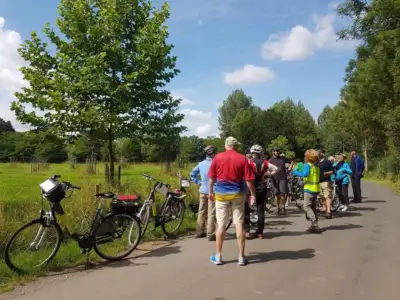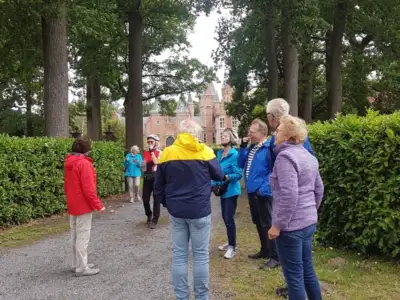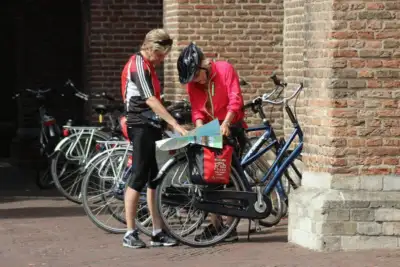
Bike and Barge Tour France: During this 15 day bike & barge trip through Flanders (Belgium) and northern France, from Bruges to Paris, you will cycle through attractive areas, not yet discovered by mass tourism. This tour is characterized by a wide variation in landscapes and has all the ingredients a good bike & barge tour needs to explore these interesting regions.
The first stage in Belgium features highlights like magnificent Bruges as unbeatable start of a beautiful discovery tour, history in medieval Ghent, tapestry in Oudenaarde, Vincent van Gogh’s heritage, a nice Belgium beer at end of your daily cycling tour. Highlights in France are World War I battle fields and memorials in the Somme valley, the Chateau de Chantilly and its art gallery the Musée Condé that houses one of the finest collections of paintings in France, and – last but not least – beautiful Paris, the “City of Lights”.
The cycling tours go over gently forested undulations and across open farm land, along the rivers Scheldt, Somme, Oise and Seine; the Belgian-French border also appears to be more or less the watershed between the river basins of Scheldt and Seine.
As well as being able to discover many picturesque villages each day – both on your bicycle and on foot – you will be able to:
The ship – Your sailing hotel
In between cycling excursions, you cruise along with the ship, which travels to a new destination every day. You dine, sleep and eat breakfast on board. You’ll receive a packed lunch every day, and you can usually choose between a longer or shorter bike ride. It’s also possible to spend a day on board if you like. There are rental E-Bikes on board, this tour will be offered as an E-Bike only tour.
Fully Guided
Accompanied by a competent, professional and multilingual tour leader, you and the group will visit interesting sights and places on the daily cycling tours. During the E-bike tour, they will explain the local history and culture behind the things you encounter along the way. You can also choose to ride individually with the help of our Ride with GPS app and our BBT cycling map (available on board).
Embarkation and check-in is at 2 p.m. in the center of Bruges. After a welcome meeting with the crew there is time for bicycle fitting and a short test-ride. After dinner the tour leader will take you for a walk through the center of town.
We advise you to come to Bruges one or more days earlier, so that you will have plenty of time to discover this interesting city.
Bruges, also called “Pearl of Flanders”, is probably the most beautiful of all Flemish cities. Its old center, which dates from the middle Ages, is almost completely intact. In that period Bruges was a metropolis and – after Paris – the 2nd largest city of Europe, center of trade and art, which you can still fully enjoy.
After breakfast you’ll start cycling. You will zigzag through charming woodland and pasture. Half way the canal between Bruges and Ghent your barge will be waiting for you. Once everyone is on board the anchor will be lifted to continue by barge to Ghent.
Ghent is a lively university city, also with a rich past. The city has its origins in Roman times, at the confluence of the rivers Leie and Scheldt. This favorable site resulted in great prosperity over the years, which had its peak late 13th, early 14th century. Textile manufacturing brought great wealth. In the city center many old patrician houses have been preserved. In the Clothmakers’ Hall (1425) textile merchants used to meet. Ghent’s major church is St. Baafs’ Cathedral, raised in various ages and in various styles. In the cathedral you can admire a number of masterpieces of medieval painting, of which the “Adoration of the Lamb” by Jan van Eyck is the most famous.
This morning you will cycle back into downtown Ghent, where you can make a nice tour through the historical center with a small canal boat. In the late morning you will hop on your bicycles again, onwards to Oudenaarde. Oudenaarde is a small town, which was situated on the border of the French German Empire, so the town was the involuntary witness (and victim) of many wars. Because it was often in the firing line, there was always someone on the lookout. The statue of most famous watchman, “Hanske de Krijger”, still stands on the magnificent town hall, that was built in the first half of the 16th century and is one of the most beautiful in Flanders. Style is Brabant late gothic, material is sandstone from Balegem. Oudenaarde is also known as the town of tapestry weavers. The tapestries became famous all over the world. Before reaching Oudenaarde you will visit an interesting archaeological site (of an old Abbey) Ename which is located at the eastside of the river Scheldt.
Before leaving Oudenaarde, there is a guided visit to the beautiful town hall. After that you will follow the river Scheldt upstream and cross the linguistic frontier, thus arriving in the Wallonia region. From now on people speak French and villages, towns, and cities have French names. Today’s destination is Doornik or (in French:) Tournai, one of the oldest towns of Belgium. Doornik was under French government until the early 17th century. Just like in Oudenaarde, after the decline of textile industry, tapestry became important here. In 1940, the entire town center was destroyed in a German air raid, but renovation of the center of town has been very successful. Especially the Notre Dame Cathedral (12th and 13th century) is worth seeing. Also the Belfort, built around 1200, is definitely worth a visit. Today there is no dinner on board. You can select one of the local restaurants.
During breakfast the barge cruises into the direction of the Belgian-French border, through the so called “white land”, where (white) limestone has been quarried since Roman times. Around the village of Bleharies at the border, you will start today’s bicycle ride. The tour goes through open farm land, through little mining towns towards Lewarde, where a mining museum can be visited. You will spend the night in Arleux.
The barge leaves the large canal and will from now on follow the Canal du Nord. The construction of this canal was already planned in 1903, but it took until 1966 to finish the works. It was constructed to replace the older and smaller Canal de St. Quentin, constructed by Napoleon in 1801, to transport coal from the mines to the north. Your cycling tours leads to the city of Cambrai, once a Roman provincial capital and an important destination for pilgrims. Worth seeing are the impressive restored buildings of the city fortress, built under Charles V. Later we cycle to the top of the Canal du Nord where the barge stays the night next to farmland.
The Canal du Nord has 2 tunnels, where the barge has to sail through. The longest one is the tunnel of Ruyalcourt, which is 4,350 meters (2.7 miles) long. This morning the barge will sail through this tunnel with you on board. Above the tunnel is the watershed between therivers Escaut (Scheldt) and Somme. From here the barge goes downhill again to Péronne.
After passing the tunnel you will continue cycling through the valley of the river Somme through sparsely populated open and rolling landscape. At the end of World War 1, this area was the frontline of the battle around the Somme. You will continue cycling to Péronne.
Today the barge will stay in Péronne. The barge will be moored just outside this charming town with its intimate square and church as well as a castle and the fascinating Grande Guerre museum.
During breakfast the barge will bring you to the little village of Épénancourt. There you have to get on the bicycles in time for a long ride through gently rolling, open countryside to the art-deco town of Ham and along the river Somme and other picturesque villages. Destination is Noyon with its imposing cathedral.
From Pont l’Évêque you will set course for Compiègne. You will ride through the forest of Ourscamp and cross the river Aisne where the forest of Compiègne begins. Here, at “Clairière de l’Armistice”, French and German generals signed a Treaty to end World War I. You can visit the small but interesting museum that tells the story. Soon you will arrive at Compiègne. The town owes its magnificent buildings to the proximity of Paris and the great woods, where the French kings loved to stay and hunt. The gardens of the Chateau de Compiègne are definitely worth a visit. Today there is no dinner on board. You can select one of the local restaurants.
Today you cycle first through the forest south of Compiègne, after which you will follow the valley of the Oise further downstream into the direction of Pont-Ste-Maxence. In the middle of the forest lies the little town of Pierrefonds, where you can admire the exterior of the “Disney-like” castle with the same name. Pont Ste. Maxence owes its name to the fact that in the Middle Ages here was one of the very few bridges over the Oise river. It became a place to spend the night for merchants and kings, who were on their way between Flanders and Paris.
After a sailing breakfast you start cycling out of Creil towards the precious and famous Castle of Chantilly, also very known for the horse racing circuit and royal stables and for its art gallery – the Musée Condé – that houses one of the finest collections of paintings in France. After the visit you continue through a nice forest. If you take the short option, you will be picked up by the barge at Beaumont. The long option will cross the river Oise and follow the river to Auvers-sur-Oise, where Vincent van Gogh spent the last days of his life and where he and his brother Theo are buried on the cemetery. You will have the possibility to visit Van Gogh’s grave on the local cemetery during a short evening walk. This region was very popular among impressionist painters.
Since you arrived in Auvers late yesterday, you can first spend some time in Auvers to search for “the soul of Van Gogh”. Then, full of impressionist impressions, you will cycle in the direction of the Capital of Light. There is time for lunch at Conflans Sainte Honorine, where the Oise and Seine rivers merge. Conflans has been an important shipping center in Northern France since the 19th century. In the afternoon you will cycle up to the castle of Saint-Germain-en-Laye from where you will have a splendid view over Paris. After that you will continue along the river to Bougival, where you will spend the night.
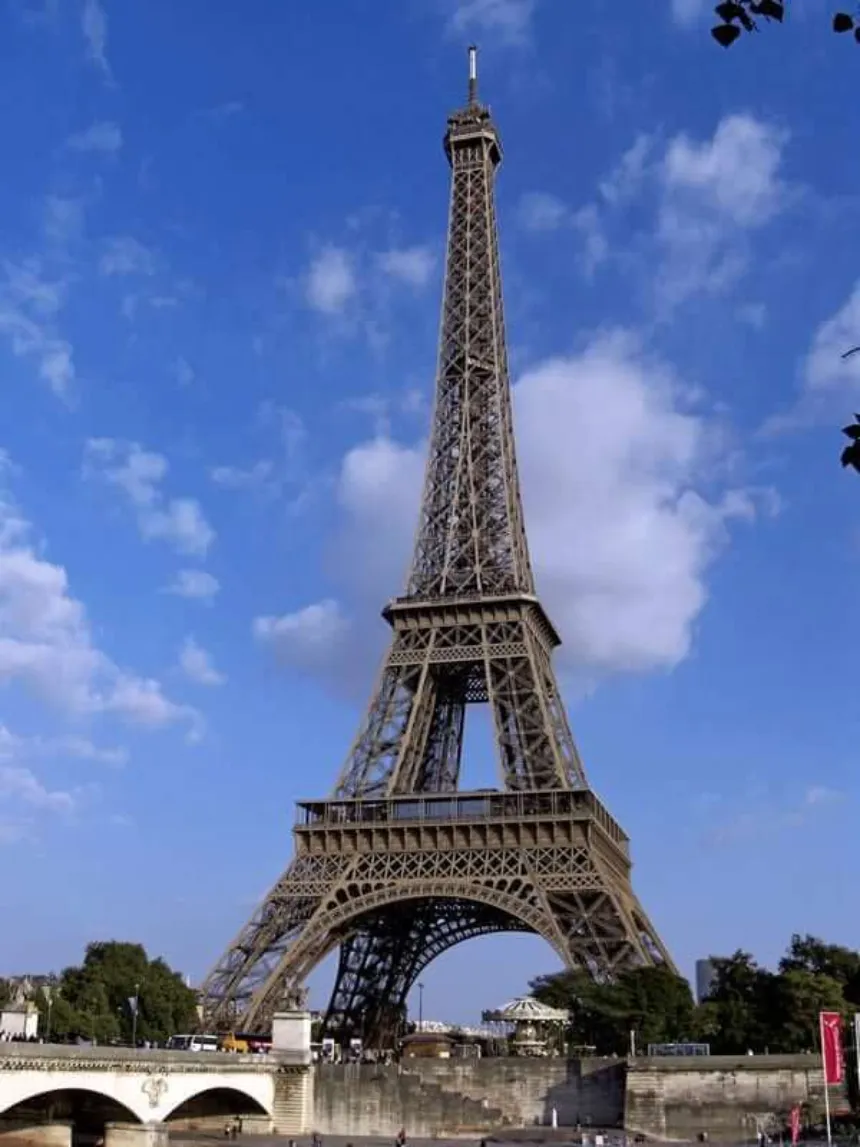
Today the barge finally cruises the Seine, upstream into Paris. It is not far in a straight line, but the Seine makes a number of large meanders here. You will cruise right through the center of Paris. You can spend the rest of the day as you like. You can explore the city by subway, or take a bus roundtrip that takes you along all major sights.
End of your tour: Disembarkation after breakfast until 9.30 a.m.
Details: In italics printed parts will be covered by the ship.
INCLUDED:
NOT INCLUDED:
Transfer between Paris and Bruges: There is a good train connection between these two cities. Please visit one of the following websites for timetables, tickets or more information www.omio.com or www.trainline.com.
| Cabins | Prices p.p. |
|---|---|
| Twin cabin | € 4.359,- |
| Twin cabin for single use | € 6.538,50 |
2027
Transfer between Paris and Bruges: There is a good train connection between these two cities. Please visit one of the following websites for timetables, tickets or more information www.omio.com or www.trainline.com.
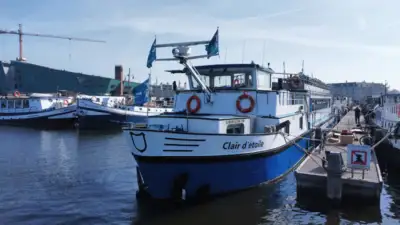
Claire d´Etoile
24 guests max
24 beds
Private charter on request
Interested in this tour? Tell us your preferred dates, cabins, and bikes, and we’ll confirm real availability with the barge.
Inquire Now